In the field of EPS (expanded polystyrene) recycling, the treatment of EPS dust (polystyrene dust) and EPS blocs (polystyrene blocks) has always been two major challenges in the industry. EPS blocs are bulky but lightweight, and the transportation and storage costs remain high; EPS dust particles are fine, difficult to collect and easy to cause secondary pollution. The emergence of foam densifiers provides an innovative and efficient way to recycle both forms of EPS waste at the same time, not only increasing the resource recovery rate but also significantly reducing environmental risks and economic costs in the recycling process.
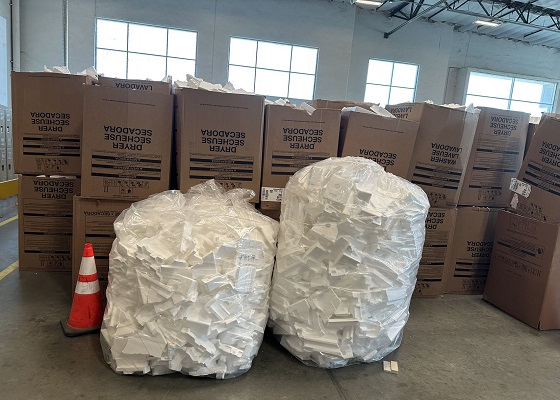
The dual dilemma of EPS dust and EPS blocs recycling
As a material widely used in packaging, building insulation, electronic cushioning and other fields, EPS will form two main forms of waste after disposal. EPS blocs mostly come from large packaging foam, waste insulation boards, etc., which have a very low density, usually weighing only 10-20 kg per cubic meter, which makes the vehicle loading rate extremely low during transportation, and the transportation cost per ton is 4-6 times that of ordinary goods. At the same time, a large number of EPS blocs accumulation needs to take up a huge amount of space, and for recycling companies, the storage pressure is extremely high, and many small recycling points are forced to give up recycling due to lack of space.
EPS dust is mainly produced in the processing and cutting process of EPS products and the crushing process of EPS blocs, and its particle diameter is usually between 0.01-1 mm. Due to its light weight and strong fluidity, EPS dust is easily dispersed by the wind during the collection process, and according to industry data, the recovery rate of EPS dust is less than 50% under traditional manual collection methods. Unrecycled dust not only causes waste of resources, but also enters the air, water and soil, causing pollution to the environment, and long-term inhalation will endanger the health of the human respiratory system. In addition, EPS dust is difficult to compress when recycled alone, and the reuse cost is extremely high, and many companies have to treat it as landfill, further exacerbating the environmental burden.
How the FOAM Densifier works and the benefits of synergistic recycling
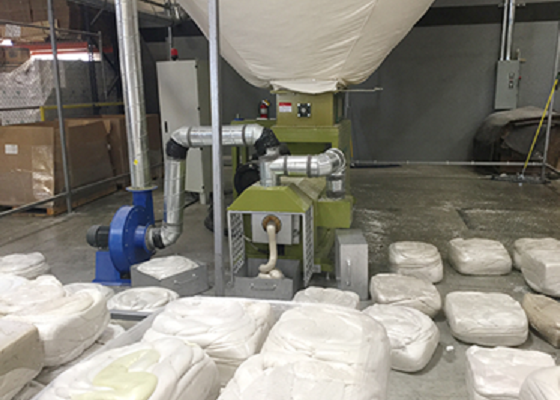
The core advantage of the FOAM Densifier is that it can process both EPS dust and EPS blocs at the same time, and efficiently convert both into high-density recycled raw materials. Its workflow is mainly divided into three stages: first, the EPS blocs is fed into the crushing unit and crushed into pieces of 2-3 cm; At the same time, the equipment accurately sucks the scattered EPS dust into the feeding channel through the built-in negative pressure suction system to ensure that the dust does not escape. Subsequently, the crushed EPS fragments and EPS dust are fully fused in the mixing chamber and enter the heating and melting zone, and the EPS material gradually melts into a viscous fluid at a constant temperature environment of 160-190°C, during which the chemical properties of the material remain stable. Finally, the molten fluid is fed into a compression molding mold, where under high pressure it forms dense blocks with a density of 700-900 kg/m3, which are uniformly sized and hard, making them easy to store and transport.
With the increasingly stringent environmental protection policies and the deepening of the concept of circular economy, the market demand for FOAM Densifier will continue to grow. In the future, the equipment is expected to be combined with intelligent technology to monitor feed volume, temperature, pressure and other parameters in real time through sensors to achieve automatic adjustment and further improve recycling efficiency. At the same time, for different types of EPS waste (such as flame retardant, color EPS, etc.), special treatment modules will be developed to expand the scope of application. It is foreseeable that foam densifiers will become the core equipment of the EPS recycling industry, playing a key role in promoting the closed-loop recycling of EPS materials and reducing “white pollution”.