In many fields of industrial production, granulation technology plays a crucial role. Granulators, as the core equipment for implementing this technology, can process different states of materials into particles with specific shapes and properties, meeting various production needs. Among them, the granulation process for loose materials and compressed materials has its own characteristics, involving different principles, processes, and equipment choices. A deep understanding of these aspects is significantly important for optimizing production processes, improving product quality, and reducing production costs.
Comparison and Selection of Granulation of Loose Materials and Compressed Materials Differences in
Granulation Principles and Processes
The granulation of loose materials mainly relies on the role of binders or the agglomeration characteristics of the materials themselves under specific conditions to achieve particle formation. For example, in disk granulation, liquid bridges are formed between material particles through the binder, promoting particle agglomeration; in fluidized bed granulation, the binding and expansion of material particles are achieved through the combined action of binders and hot air in a fluidized state. These granulation methods usually require the addition of a certain amount of binder to the materials, and some processes involve a drying process to remove solvents or moisture from the binder. In contrast, the granulation of compressed materials is primarily based on the principle of pressure forming. By applying high pressure to the materials, plastic deformation and brittle fracture occur, thereby achieving particle densification and shaping. In the compression granulation process, binders usually do not need to be added (except in special cases), and since it is a dry granulation method, there is no drying step, making the production process relatively simple and direct.
Equipment Selection and Investment Costs
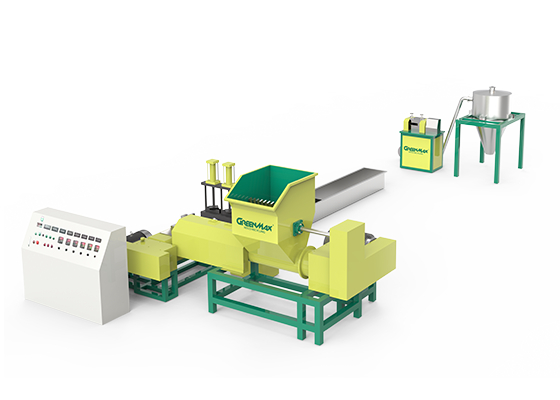
For granulating loose materials, corresponding equipment needs to be selected based on different granulation methods. A disc granulator has a relatively simple structure and low investment costs, but its production efficiency is relatively limited, making it suitable for small-scale production. Fluidized bed granulators and spray granulators are more complex in equipment structure, have a higher degree of automation, and involve larger investment costs, but they have strong production capacity and stable product quality, making them suitable for large-scale industrial production. At the same time, these machines also require corresponding binder supply systems, drying systems, etc., which further increases equipment investment and operating costs. Compression granulation equipment, such as roller compactors and granulators, has a more compact structure, but has higher requirements for equipment strength and precision, so the cost of procuring such equipment is also relatively high. However, due to the relatively simple process of compression granulation, which does not require complex binder addition and drying equipment, if the production scale is large and the equipment is reasonably configured, the overall investment cost may be comparable to or slightly lower than that of large-scale production equipment for granulating loose materials.
Product Quality and Performance Characteristics
The pellets produced from granulating loose materials have relatively flexible shapes and sizes, which can be controlled by adjusting equipment parameters and process conditions. The strength and stability of the pellets depend to some extent on the type and amount of binder as well as the control level of the granulation process. Generally speaking, the binding force within the pellets is relatively weak, and in some applications that require higher pellet strength, further post-treatment may be necessary to enhance pellet performance. On the other hand, pellets produced from granulating compressed materials are formed under high pressure, resulting in higher density and strength, and good stacking stability. The particle size is mainly determined by the size of the mold or the roller surface cavity, with a relatively narrow particle size distribution, leading to more uniform product quality. However, for some applications that require very complex or special shapes for the pellets, compression granulation may be somewhat lacking in flexibility.