In the production of waterproof materials, expanded polystyrene (EPS) is widely used because of its lightweight structure, thermal insulation properties, and excellent cushioning performance. However, during the manufacturing process, especially when EPS sheets or blocks are cut into specific shapes, a significant amount of EPS offcuts and scraps are generated. These irregular EPS edge scraps are difficult to store and transport due to their bulky volume and low density. As a result, many waterproof material manufacturers are turning to the EPS melting machine as an effective solution to recycle and reduce EPS waste.

EPS scraps generated during the cutting process usually accumulate quickly in production workshops. Because EPS is composed mostly of air, even a small amount of material can occupy a large storage area. If these offcuts are simply discarded, they not only waste valuable material but also increase disposal costs and environmental pressure. Using an EPS melting machine allows manufacturers to process these loose EPS scraps directly on-site, significantly reducing their volume and converting them into dense recyclable material.
The working principle of an EPS melting machine is relatively straightforward. EPS scraps are fed into the machine where they are heated and melted. As the foam structure collapses, the material becomes a dense molten mass which is then extruded and cooled into solid blocks or ingots. Through this process, the volume of EPS can be reduced by up to 90%. The compacted material is much easier to store, transport, and sell to recycling companies that reuse it to produce plastic products or other materials.
A waterproof material manufacturer in Europe recently adopted a GREENMAX EPS melting machine to manage the EPS waste generated from cutting insulation boards used in waterproof roofing systems. Before installing the equipment, the factory faced constant challenges with scattered EPS offcuts that occupied valuable floor space in the workshop. The lightweight scraps were also easily blown around, making cleaning and handling difficult for workers.
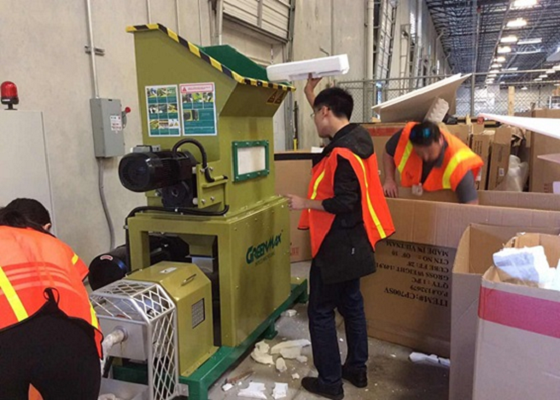
After introducing the GREENMAX EPS melting machine, the factory began collecting EPS edge scraps directly from the cutting stations and feeding them into the machine throughout the day. The equipment continuously melted the waste EPS and produced dense EPS ingots. This significantly reduced the storage space required for waste material and improved the overall cleanliness of the production environment. More importantly, the recycled EPS blocks could be sold to plastic recyclers, turning what was once a disposal problem into a new source of revenue.
Today, the EPS melting machine has become an increasingly important piece of equipment for manufacturers that generate large amounts of EPS cutting waste. By reducing volume, simplifying storage, and enabling material recovery, it helps waterproof material producers improve both environmental performance and operational efficiency while promoting a more sustainable recycling system.