With changes in urban lifestyles, fresh supermarkets have become an important channel for citizens to obtain seafood, fruits, and cold chain foods. However, the large amount of discarded foam packaging (mainly EPS foam boxes) has posed a significant challenge for environmental management. Traditional disposal methods such as landfilling and incineration not only pollute the environment but also waste resources. The introduction of EPS Compactor (foam compactor) equipment provides an economically efficient green solution for handling waste foam in fresh supermarkets.
Current Situation: The Foam Waste Dilemma in Fresh Supermarkets
EPS (expanded polystyrene) is widely used in insulation boxes for fresh cold chain transportation.
For example, a medium-sized fresh supermarket in a city may produce 200 to 500 discarded EPS foam boxes daily, accumulating more than 20 tons of waste annually. These foams have several characteristics:They require a large storage space and have very low transport efficiency; if disposed of carelessly, they lead to “white pollution”; most supermarkets lack specialized equipment for compression or recycling; they affect hygiene and storage.
Solution: Introducing EPS Compactor for Compression Recycling
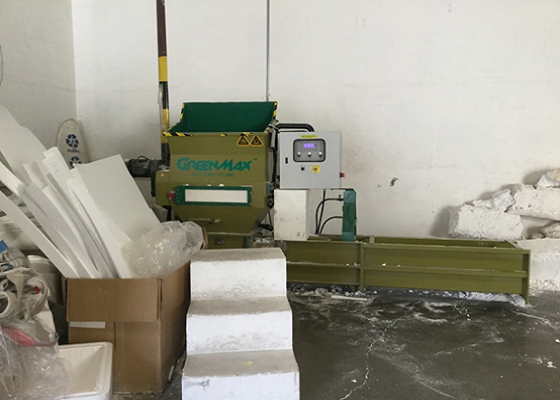
EPS Compactor is a specialized equipment used for compressing and processing foam materials, especially EPS. It can crush loose, bulky foam boxes and compress them into dense “foam bricks” under high pressure, significantly reducing their volume.The recycling process is as follows:Collection and Preprocessing
Staff members gather discarded EPS boxes in one location and simply clean out debris (such as plastic bags and cling film).Feeding and Compression
The EPS foam is fed into the Compactor equipment, where it is crushed and extruded through a screw to form high-density blocks.Storage and Recovery
The compressed EPS bricks are neatly piled up, waiting to be transported to a plastic recycling plant or a regeneration granulation company.Recycling Utilization
Regenerated EPS granules can be used to manufacture environmentally friendly plastic products such as picture frames, hangers, and stationery board materials.
Actual Benefit
AnalysisEnvironmental Benefits:
- Significantly reduce supermarkets’ reliance on landfills or sanitation systems;
- Effectively address the source of “white pollution”;
- Contribute to creating an image of “green stores” and “zero waste stores.”Economic Benefits:
- Compression ratio up to 1:50, greatly reducing storage and transportation costs for foam;
- Compressed blocks can be sold to recyclers;
- Some local governments provide subsidies or points rewards for environmental protection equipment.By introducing the EPS Compactor, fresh food supermarkets no longer view foam waste as a burden but integrate it into a recyclable regeneration system. This is a crucial step towards achieving environmental protection, efficiency, and effective operation, as well as an important manifestation of actively undertaking social responsibility in the context of “dual carbon” goals.