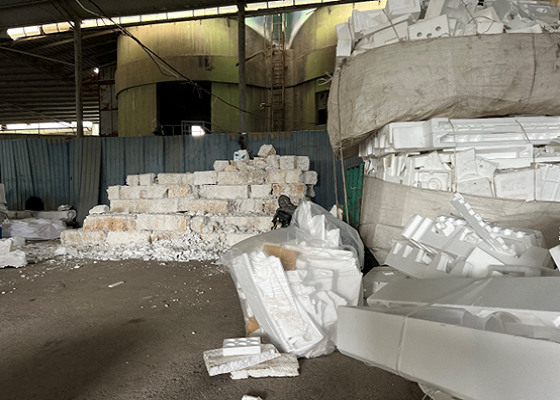
With the increasing stringent environmental regulations, the recycling of EPS (expanded polystyrene) waste has become particularly important. As a lightweight but bulky material, EPS is widely used in home appliance packaging, food incubators, building insulation boards and other fields, but its low-density characteristics also make transportation and handling costly. The EPS Compactor, or EPS Foam Compressor, is designed to address this challenge and efficiently compress the foam volume and reuse resources.
This guide will systematically introduce how to use EPS Compactor for EPS recycling from five aspects: equipment principle, recycling process, operation steps, safety points, and common problems.
How EPS Compactor works
EPS Compactor can be reduced in the following two ways:
Mechanical compression type (cold pressing): Relies on hydraulic or spiral propulsion to physically compress EPS into high-density blocks, without heating, and retains the characteristics of raw materials.
Hot Melt: EPS foam is heated and melted and extruded into strips or blocks, with a higher volume compression ratio, which is suitable for subsequent granulation or injection molding reuse.
Both types can compress the volume of EPS to 1/50~1/90 of the original, which greatly improves the efficiency of transportation and storage.
Preparation process before recycling
In order to ensure the compression efficiency and the service life of the equipment, it is recommended to complete the following preparations before using the EPS Compactor:
Clean Scrap: Remove tape, labels, stains, and metal nails from the EPS to prevent clogging the machine.
Classification treatment: Distinguish EPS from other types of foam or plastic to avoid mixing with foreign matter.
Shear size: Large EPS sheets or packs can be cut manually first, which is convenient for feeding.
How-to guide
The following is a typical process of using EPS Compactor (taking the cold press type as an example):
1.
The device boots up
Check the power connection and control panel status
Turn on the mains power and start the hydraulic or screw system
Feeding treatment
Slowly put the EPS scrap into the inlet
If it is a large foam box, it can be crushed by an auxiliary crushing device
Compression process
The machine automatically pushes the EPS into the compression cavity and extrudes it
Compression blocks are pushed out from the outlet, stacked or packed
Regular cleaning and shutdown
Clean the feed port and compression chamber after each use
Disconnect the power supply and clean up the residue before a long shutdown

Essentials for safe operation
Operators must be trained in the use of the equipment and wear protective gloves and goggles
Do not put your hand in the inlet, especially when the equipment is running
If the equipment is stuck or makes abnormal noise, it should be stopped immediately for troubleshooting
Regularly check whether the electrical control box, hydraulic system, and heating components (if any) are in good condition
The EPS Compactor is an efficient, environmentally friendly and easy-to-operate recycling device for EPS recycling scenarios of all sizes. By using the equipment correctly, recyclers can not only significantly reduce logistics and disposal costs, but also make a positive contribution to resource recycling and carbon reduction goals.