With the increasing awareness of environmental protection, the recycling industry has developed rapidly around the world. However, with the rise of furniture return and exchange centers, accompanying problems have gradually emerged, among which the problem of polystyrene foam (Expanded Polystyrene, EPS) waste is the most prominent.
What is the process of EPS waste generated by the return and exchange center?
Generally, when returning or exchanging goods, the furniture will first be sent to the return and exchange center to check the quality of the goods, whether it meets the return and exchange standards, and whether it will affect secondary sales. In this way, the original EPS packaging needs to be disassembled and waited until it is sold again. When the time comes, it needs to be replaced with new EPS packaging. In this way, the return and exchange centers of large companies will generate a lot of EPS waste packaging.
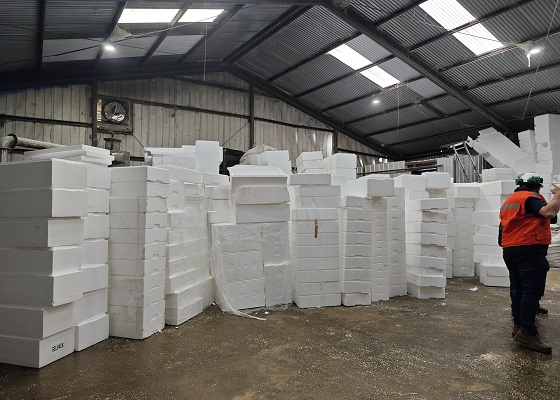
EPS material is widely used in furniture packaging due to its lightweight, thermal insulation and shock-proof characteristics. When the return and exchange center handles returned furniture, it is often necessary to remove and process a large amount of EPS packaging materials. However, due to the non-degradability of EPS materials and their long-term residue in the natural environment, EPS waste has caused a great negative impact on the environment. If a large amount of EPS waste is not properly processed, it may spread to the natural environment through wind or water flow, harming wildlife and polluting water bodies.
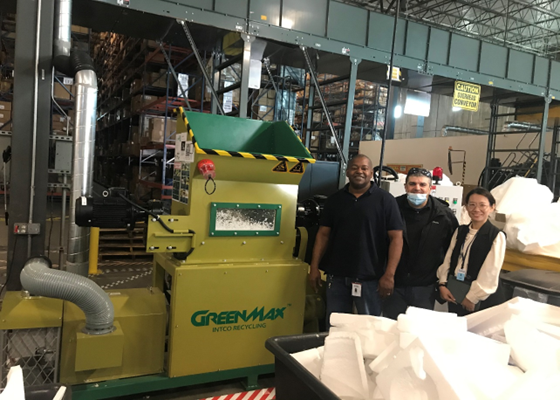
Currently, among the customers GREENMAX cooperates with, the United States produces the most EPS furniture packaging. These American customers generally use hot melt technology for EPS recycling. GREENMAX EPS densifier is also widely used in this industry. The best-selling EPS densifier is the M-C200 model. The medium model is not only suitable for small and medium-sized recycling equipment, but also for booming enterprises.