In modern society, foam plastics are widely used in packaging, construction and other fields. However, the recycling of foam plastic has always been a problem, mainly due to its bulky size, low density, and high transportation and processing costs. These problems can be effectively solved by using foam compactor, especially for recycling XPS foam and EPS foam.
Classification of foam plastics
XPS foam
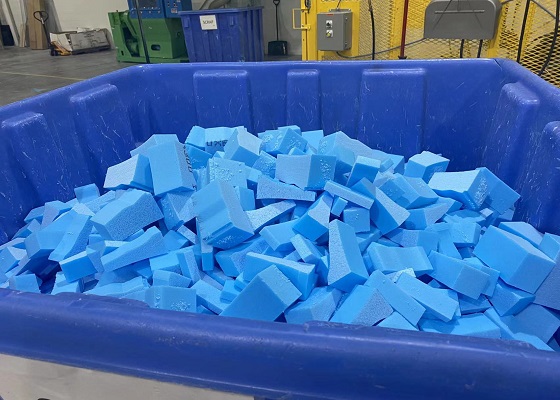
XPS foam is made of polystyrene through extrusion molding. It has excellent thermal insulation properties and compressive strength and is widely used in building insulation materials. XPS foam has a uniform structure, high closed cell ratio, and good water resistance and durability.
EPS foam
EPS foam is formed by heating and foaming polystyrene beads. It is light in texture, has good cushioning properties, and is widely used in packaging materials. EPS foam contains a large amount of air inside, so it has good thermal insulation and shock-proof properties.

How Foam compactor works
Foam compactor is mainly used to compress low-density foam plastics and greatly reduce their volume to facilitate storage and transportation. GREENMAX foam compactor processes foam plastics through mechanical compression: Foam compactor squeezes foam plastics into dense blocks through physical compression. This method works for most foam plastics. GREENMAX’s equipment realizes this recycling method through crushing and screw extrusion, compressing the huge EPS foam and XPS foam into 1/50 of its original volume.

Recycling XPS foam and EPS foam using a foam compactor is an efficient and environmentally friendly method. Through mechanical compression and thermal melt compression, the volume of foam plastics can be greatly reduced, reducing transportation and storage costs, while effectively recycling and reusing, reducing environmental pollution. With the continuous advancement of technology and the promotion of applications, foam compressors will play an increasingly important role in the field of foam plastic recycling.