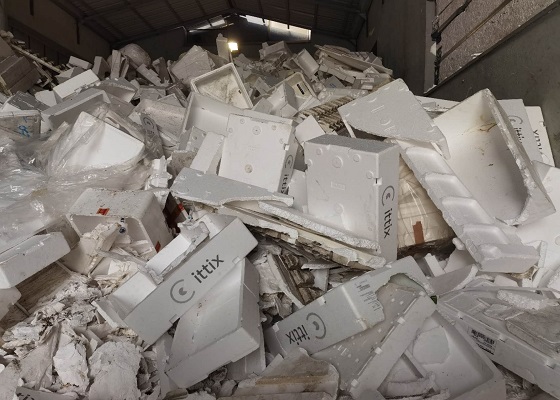
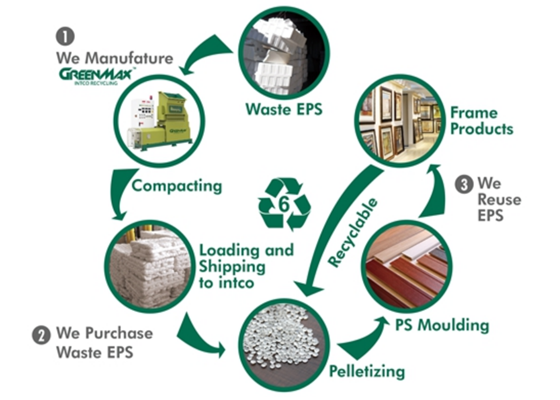
Among the more than 14 million tons of EPS foam waste generated globally each year, less than 10% is effectively recycled. This lightweight yet stubborn material has long been an ‘environmental dilemma’ due to its large volume and high transportation costs. The GREENMAX series recycling equipment, independently developed by Intco Recycling, uses a physical mechanical method to create a complete closed loop from EPS foam collection and volume reduction to pellet regeneration. It not only increases recycling efficiency to more than five times that of traditional methods but also turns a former ‘environmental burden’ into high-value plastic pellet resources.
From Fluffy Waste to Dense Material: A Revolutionary Breakthrough in Volume Reduction Technology
The GREENMAX foam compactor (such as the Z-C200 model) uses screw cold compression technology to compress foam waste containing 95% air to 1/50 of its original volume without damaging the EPS molecular structure. The practice of Malaysian recycler Chen Weicun Co., Ltd. shows that after introducing this equipment, what originally required 10 trucks to transport loose foam can now be accomplished with only 2 trucks after compression, reducing monthly logistics costs by 60%. The built-in dust removal system can filter 98% of fine particles, and together with the intelligent temperature control module, ensures the compression process produces zero emissions and no odors, fully complying with EU RoHS environmental standards.
For complex EPS waste with attached oil or labels, the GREENMAX pre-treatment production line uses a three-stage crushing and screening process. The foam is first shredded into 3-5mm particles, then impurities are separated through an infrared sorting machine, and finally, the material passes through a dewatering machine to remove surface moisture. A case study at the Shanghai Fengxian base shows that this process can increase the purity of EPS raw materials to 99.5%, laying a foundation for subsequent granulation.
Regranulation Process: Giving Waste Material a High-Value New Life
The compressed EPS blocks are fed into the granulation system via a closed conveyor belt, then melted and plasticized through a twin-screw extruder (with temperature controlled between 180-200°C), and filtered through a high-precision mesh to remove trace impurities. Finally, they are cut into recycled PS pellets with a diameter of 3mm. At Incoe’s Malaysia recycling plant, 12 high-end PS granulation lines have an annual capacity of 80,000 tons. The produced r-PS pellets achieve a tensile strength of 28 MPa, close to the level of virgin material, and can be directly used to manufacture consumer products such as picture frame trims and decorative panels.