With the increasing awareness of environmental protection, the recycling of foam plastics has become an important issue. In particular, the widely used expanded polystyrene (EPS) poses huge challenges to waste disposal and environmental protection due to its large size, light weight, and difficulty in degrading. Currently, chemical recycling and mechanical recycling are the two main recycling methods. This article will compare the principles, advantages and disadvantages of these two recycling methods.
Chemical recycling
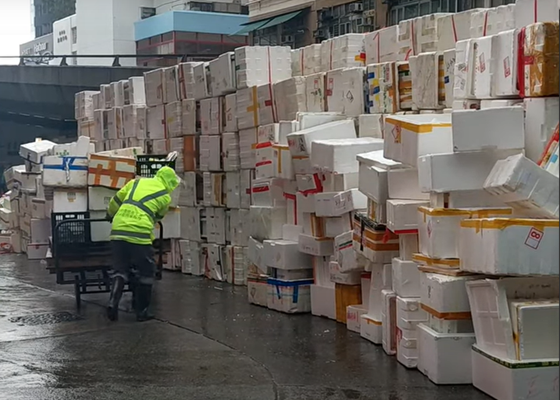
Chemical recycling uses chemical reactions to break down foam into its basic chemical components and then re-synthesize it into new materials. This usually involves the following steps:
- Dissolve: Use a specific solvent to dissolve the foam and reduce its volume.
- Separation: Separating useful chemical components from a solution by distillation or other methods.
- Recombination: Recombine the separated components into new polystyrene or other chemicals.
Advantage - Efficient recycling: Chemical recycling can handle severely contaminated or mixed foam plastics, with a high recovery rate.
- Resource reuse: Foam plastics can be decomposed into high-purity chemical raw materials for use in manufacturing new plastics or other products.
- Reduce environmental pollution: By completely degrading foam plastic, it can reduce its long-term pollution to the environment.
Shortcoming
- High cost: The chemical recovery process is complex, and equipment and operating costs are high.
- High technical requirements: advanced technology and strict operating specifications are required, and secondary pollution may occur during the treatment process.
- High energy consumption: The chemical recycling process usually requires high temperature and high pressure environment, which consumes a lot of energy.
Principle of mechanical recycling method
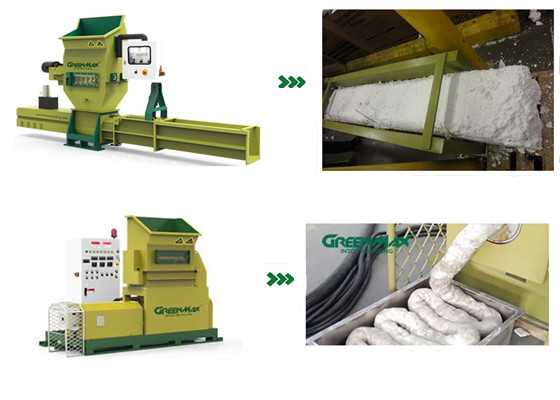
Compressing foam, for example with a foam compactor, reduces its volume, making it easier to store and transport. The workflow is as follows:
- Crushing: Crushing large pieces of foam plastic into small pieces.
- Compression: Use screw extrusion to compress small pieces of foam plastic into high-density blocks. The compression ratio of GREENMAX foam compactor can reach 50:1
Advantage - Low cost: The equipment and operating costs of foam compactor are relatively low.
- Easy to operate: no complex chemical reactions are required, and it is easy to operate and maintain.
- Easy to transport: The volume of compressed foam plastic is greatly reduced, reducing transportation costs.
Shortcoming - Limited uses: Compressed materials are mainly used in the general market, and the purity of the recycled materials produced is not as high as that of chemical recycling methods.
Chemical recycling and mechanical recycling each have their own advantages and disadvantages and are suitable for different recycling needs and scenarios. At present, mechanical recycling methods are relatively mature and widely used. No matter which recycling method is used, as long as foam waste can be recycled reasonably, it is worthy of support.