If you read the latest foam recycling report in the United States, you will find that there are 136.8 million pounds of foam been recycled in 2019, while it was only 113.8 million pounds in 2018. With the irreversible development trend of foam recycling, foam compactor plays an important role in the use of foam. However, there are some shortcomings in the process of application, which bring negative impact to the use of foam compactor. As a company dedicated to the design of foam recycling machine, GREENMAX has made a lot of innovative designs for this.
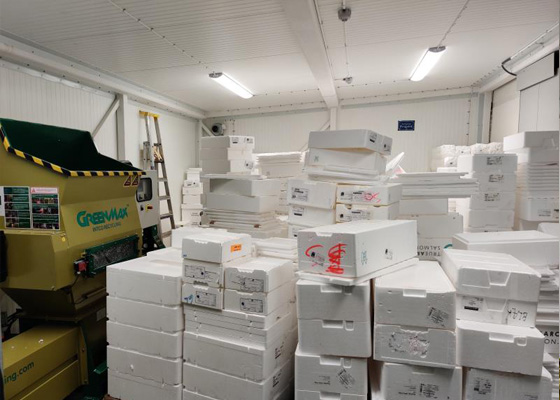
Shortcoming 1: If the size of the foam needed to be powdered is too large, it will affect the compression efficiency of the screw of the foam compactor, otherwise, it will cause difficulty in forming and easy to melt
Solution: GREENMAX adopts the structure of double cutter plus fixed cutter rail for the foam recycling machine. According to the screw size in the volume reduction system and the conveying efficiency in the feeding system, the comminution size is adapted to ensure the best screw compression capacity in the volume reduction system.
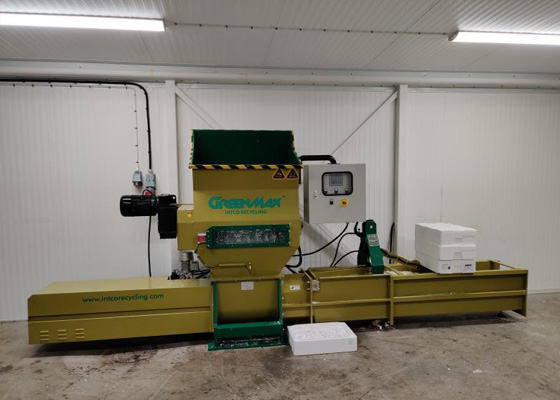
Shortcoming 2: It is difficult to ensure that the material can be pushed out in time without excessive hot melting, while the material compression rate is high, which can reduce the adverse impact on the subsequent regeneration granulation.
Solution: After many calculations and experiments by GREENMAX, the optimal reduction system of foam compactor is obtained by balancing productivity and efficiency and constantly improving the screw size. Among them, the outer diameter of the blade, the rotation speed of the screw, pitch, and angle of the screw is the key to solve the difficulty of capacity reduction.
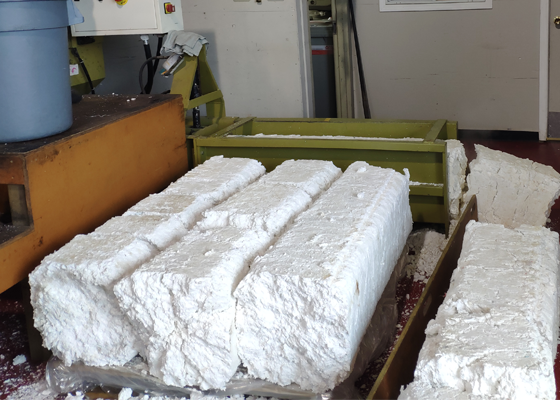
Shortcoming 3: The components of the recycling materials are often complex. The density of different materials, whether the materials are mixed or not, and whether there is water content will affect the setting parameters and treatment process of the volume reduction equipment
Solution: GREENMAX has developed two control modes: time mode and power mode. Time mode is easy to operate, mainly for materials with low density. Power mode to improve the compression ratio, the main density of the material.